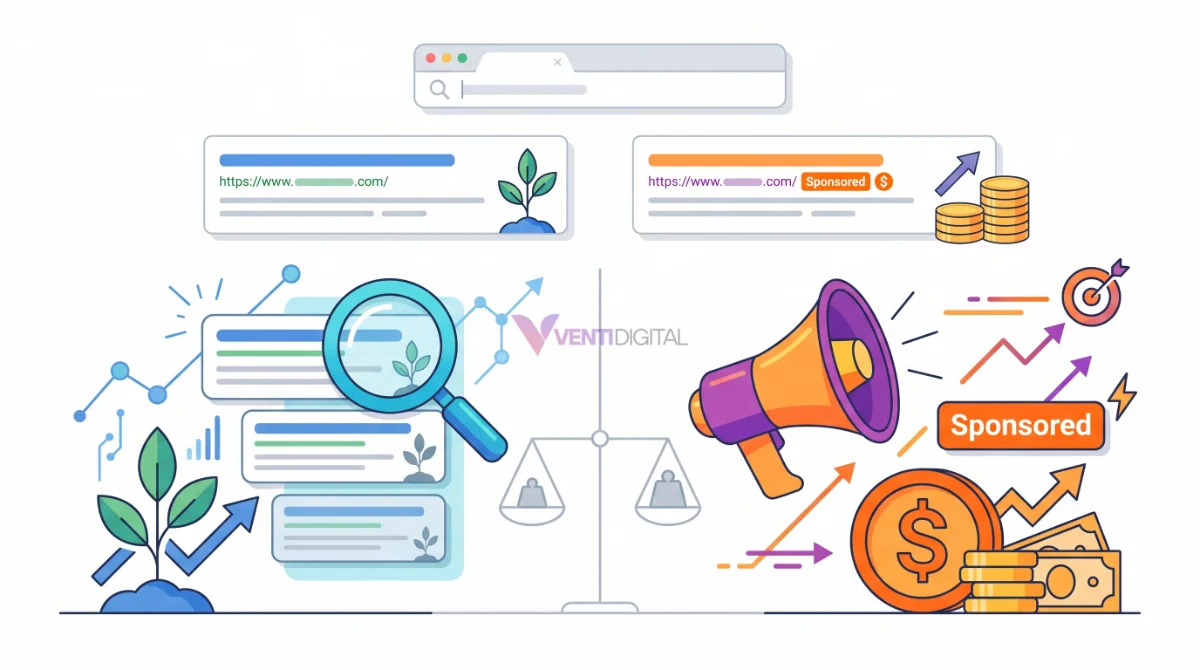
If you are planning your organization’s digital marketing budget, this question has almost certainly come up in strategy meetings: "Should we invest in SEO to build long-term organic traffic, or should we allocate capital to SEM campaigns to drive immediate conversions?"
In practice, these two terms are frequently conflated. Some treat SEO and SEM as interchangeable simply because both operate on Google. Others view them as mutually exclusive rivals, assuming an enterprise must pick one and neglect the other.
In reality, SEO and SEM feature entirely different operating mechanics, cost structures, and strategic roles in revenue generation. Understanding the fundamental trade-offs between them is not just about avoiding ad spend waste; it allows you to construct a cohesive search engine strategy that captures high-intent demand while driving down blended customer acquisition costs.
Key Takeaway: What is the Real Difference Between SEO and SEM?
The core distinction boils down to cost-per-click and speed to impact:
SEO (Search Engine Optimization) focuses on earning top positions in organic search results without paying per-click fees to Google. It requires 3 to 12 months of groundwork, but it yields a compounding digital asset that consistently delivers visitors over time.
SEM (Search Engine Marketing) leverages pay-per-click (PPC) advertising models to position your website at the very top of search engine results instantly. It provides rapid validation, but traffic ceases the moment daily ad spend stops.
Historically, SEM was used as an umbrella term encompassing both paid and organic marketing on search engines. Today, the global digital marketing industry universally defines SEM specifically as paid search advertising (such as Google Ads and Microsoft Advertising), reserving SEO strictly for unpaid, organic search.
How They Work: Two Distinct Paths to the Top of Google
To establish the right priorities for your marketing mix, it helps to understand what actually happens beneath the surface of both methodologies.
SEO: Building an Autonomous Digital Asset
Securing top rankings on Google through organic SEO is akin to developing commercial real estate in a prime location. You cannot bribe search engines for organic placement. Algorithms evaluate hundreds of quality and relevance signals before awarding top visibility.
The foundation rests on three pillars: clean technical site architecture, substantive content that solves specific user search intent, and topical authority validated by reputable external citations across your industry.
Because search engines require time to observe how searchers engage with your assets, results are never instantaneous. As analyzed in our breakdown of How Long Does SEO Take to Generate Traffic and Sales, SEO functions as a compounding financial asset. Growth starts deliberately while technical and architectural debt is cleaned up, but once authority solidifies, thousands of qualified prospects arrive every month without requiring a single dollar in media spend per click.
SEM: Renting Accelerated Visibility via Real-Time Auctions
If SEO is the process of building an asset, SEM is renting a premium billboard at a bustling intersection. The moment your Google Ads campaign is configured and funded, your links can occupy the absolute top positions on search result pages within hours.
However, ad placement is not determined solely by who bids the most money. Google utilizes an automated auction system that multiplies maximum bids by a proprietary Quality Score. The more relevant your ad copy and landing page experience are to the user’s query, the lower your effective cost-per-click (CPC) will be.
The paramount advantage of SEM is velocity. Need qualified leads today? Campaigns can be launched immediately. Yet the vulnerability is equally absolute: inbound traffic is entirely dependent on continuous budget infusion. The instant daily budgets are exhausted, customer flow halts immediately.
Side-by-Side Comparison: SEO vs SEM
To visualize the strategic trade-offs, here is how both approaches compare across key operational and commercial dimensions:
| Strategic Dimension | SEO (Organic Search) | SEM (Paid Search / PPC) |
|---|---|---|
| Traffic Cost Model | Free per click; capital is invested in technical infrastructure and content production. | Pay-per-click (PPC); your account balance is charged every time a user clicks your ad. |
| Time to Traction | Gradual; generally requires 3–6 months for initial traction and 6–12 months for maturity. | Immediate; impressions and inbound clicks begin flowing within hours of approval. |
| Traffic Longevity | Highly durable; traffic continues flowing even if active production is paused temporarily. | Transient; visits immediately drop to zero the second ad spend or daily budgets expire. |
| Targeting Control | Indirect; relies on how algorithms interpret topical depth, semantic markup, and relevance. | Extremely granular; allows precise control over schedules, geo-locations, and device types. |
| Audience Trust | High; many searchers actively bypass sponsored links in favor of authoritative organic results. | Moderate; exceptionally effective for searchers with immediate, high-intent transactional needs. |
| SERP Presentation | Standard organic links, featured snippet callouts, and conversational AI summaries. | Links labeled "Sponsored", visual Google Shopping carousels, and conversion extensions. |
Economic Reality: Cost Dynamics and Return on Investment (ROI)
One of the most consequential conversations at the executive level centers on Customer Acquisition Cost (CAC). Here, the economic nature of SEO and SEM diverges dramatically.
With SEM, costs scale linearly alongside traffic volume. If the average CPC in your industry is $5.00, acquiring 2,000 clicks requires an outlay of $10,000. As competitive density intensifies in your niche, bidding wars drive CPCs upward over time. Without aggressive conversion rate optimization, rising media costs can progressively compress gross margins.
Conversely, SEO features a front-loaded capital structure. Upfront investments focus on auditing crawlability through our Technical SEO Checklist, streamlining code efficiency via modern Web Rendering principles, and publishing authoritative topic clusters.
Early on, cost-per-acquisition for SEO may appear elevated because traffic volume has not yet scaled relative to foundational labor. But once core assets secure top rankings, traffic compounds into tens of thousands of monthly visits without incremental media costs. At this inflection point, effective blended CAC drops toward zero, transforming organic search into one of the most profitable engines of enterprise growth.
When Should Your Business Prioritize SEM First?
While SEO delivers outstanding long-term economics, specific commercial scenarios make SEM the logical priority:
- Product Launches and Market Validation: When rolling out a new service offering and requiring immediate feedback on customer willingness to pay. Waiting for organic indexation takes too long; SEM provides conversion data in days.
- Time-Sensitive Campaigns: Seasonal promotions, annual industry conferences, or product pre-orders with strict deadlines require guaranteed visibility that cannot wait for organic crawl cycles.
- High-Intent Emergency Queries: Searchers looking for urgent commercial solutions (such as enterprise data recovery, emergency facility repair, or urgent bookings) convert immediately. Securing the top sponsored slot captures demand at the exact moment of decision.
When is SEO the Non-Negotiable Priority?
Conversely, SEO must take center stage when corporate strategy focuses on margin resilience and enduring market leadership:
- Establishing Thought Leadership and Category Authority: B2B buyers and enterprise decision-makers rarely convert upon first seeing a sponsored ad. They conduct research across multiple touchpoints, evaluating deep case studies and comparative analysis organically.
- Insulating the Business from Escalating Ad Costs: In competitive verticals with punitive CPCs (such as legal, SaaS, cyber-security, and financial services), relying solely on SEM creates severe operational risk. Developing an owned organic footprint is the only way to safeguard margins against auction volatility.
- Positioning for the AI Search Revolution: Search habits are evolving rapidly. Buyers increasingly rely on conversational summaries synthesized by large language models. A structured, authoritative content ecosystem ensures your brand is selected for Google AI Overviews Strategies and cited by generative engines, as outlined in our analysis of How LLMs Select Citation Sources.
The Hybrid Approach: Combining SEO and SEM for Total Search Dominance
High-growth organizations rarely pit these two channels against each other. Instead, they synthesize them into a unified search framework:
Test and Validate with SEM, Build Assets with SEO
Marketing teams frequently spend months producing dozens of educational articles for keywords that fail to yield commercial pipeline. You can eliminate guesswork by deploying small, targeted SEM ad sets for 2 to 4 weeks across target clusters.
Analyze conversion metrics in Google Ads: which search queries drive qualified pipeline or actual transactions? Once commercial viability is validated with real spend data, transform those winning queries into long-term organic pillar content.
Defend Branded Search Real Estate
Have you ever searched for your own company name on Google, only to find an aggressive competitor’s ad occupying position one? Competitor conquesting is standard practice in digital marketing. Running a low-cost brand defense campaign guarantees you own the top ad slot while occupying the first organic rank beneath it, preventing prospects from being siphoned away.
Total SERP Real Estate Dominance
Imagine the psychological impact on a buyer searching for solutions in your space: they encounter your sponsored ad at the very top, read your brand cited in an AI overview summary, and find your authoritative technical guide holding the #1 organic position.
Occupying multiple touchpoints across the same results page maximizes aggregate click-through rates and signals unshakeable market authority, a core principle detailed in our guide to Understanding SEO, AEO, and GEO.
Conclusion
Evaluating SEO versus SEM is not about declaring a winner—it is about deploying each tool at the right time. SEM is your most effective accelerator for immediate validation, agility, and rapid pipeline generation. SEO is your strongest foundation for building durable enterprise equity and compounding returns that outlast any ad budget.
The most resilient organizations leverage SEM to generate immediate commercial momentum, reinvesting cash flow into building an owned organic search footprint that powers sustainable, profitable growth for years to come.
To explore how a unified search architecture can scale your enterprise customer acquisition, connect directly with our advisory specialists through Venti Digital Growth & Search Services.
References & Authoritative Sources
- Search Engine Land: SEO vs. SEM: Understand the Key Differences and How to Use Both
- Google Ads Help Center: How the Google Ads Auction Works and Quality Score Calculation
- WordStream by LocaliQ: Search Engine Marketing (SEM) Benchmarks and Cost Per Click Industry Data
- SparkToro & Datos Research: The Changing Landscape of Organic Clicks and Paid Search Dominance
- Google Search Central: Google Search Essentials & Ranking Documentation
- Venti Digital Research: How Long Does SEO Take to Generate Traffic and Sales?
- Venti Digital Strategic Analysis: Understanding SEO, AEO, and GEO: Why Your Business Needs All Three