Every founder, marketing director, and business owner investing in search engine optimization inevitably asks the same fundamental question: "How long will it take for our website to reach page one of Google and generate measurable revenue?"
In a fast-paced business environment demanding immediate returns, the answer to this question is frequently misunderstood. Executive stakeholders often expect rapid traffic spikes within weeks—similar to launching a paid ad campaign on Google Ads or Meta. On the other end of the spectrum, some perceive SEO as an open-ended experiment without predictable milestones or timelines.
The reality lies in how search engine algorithms build trust. SEO is not an on/off switch that delivers instant customer acquisition overnight. Instead, it functions as a compounding financial asset. In the initial phases, progress may seem quiet as foundational infrastructure is being re-architected. Once domain authority and topical relevance mature, organic traffic and inbound leads compound sustainably over time, driving Customer Acquisition Cost (CAC) down to levels paid advertising cannot match.
Key Takeaway: What is the Realistic Timeline for SEO Results?
Under realistic market conditions, a professionally executed SEO campaign typically takes 3 to 6 months to demonstrate meaningful traction in search impression volume, long-tail keyword rankings on page one, and early organic clicks. Reaching top 3 positions for competitive commercial terms and unlocking mature, consistent revenue pipelines generally requires 6 to 12 months of uninterrupted technical and editorial execution.
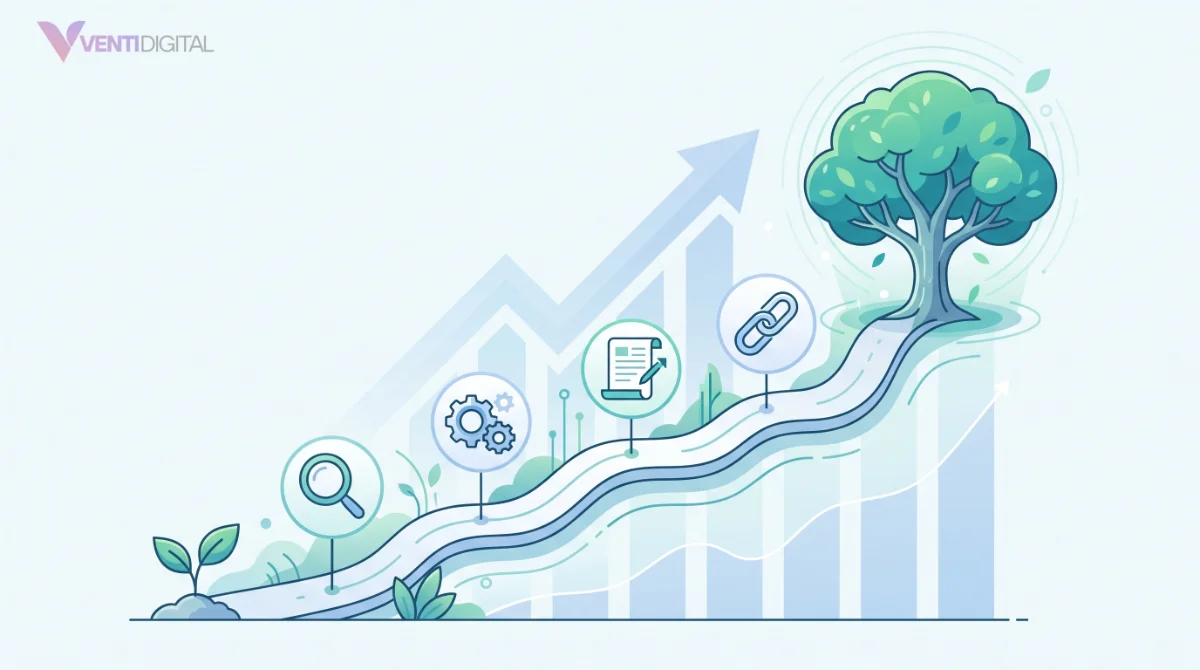
This journey unfolds across three distinct developmental stages: resolving technical debt during the first three months, validating keyword traction from months four through six, and scaling authority into predictable revenue growth throughout months seven to twelve and beyond.
Why SEO Requires Time: The Algorithmic Perspective
To understand why organic visibility does not materialize overnight, one must examine how search engines process and validate web documents. Googlebot does not crawl billions of web pages simultaneously. Rather, search engines operate under computational constraints governed by crawl budget. Fresh content and updated templates must wait in line to be discovered, rendered, and integrated into the primary search index.
Once a page is indexed, the algorithmic evaluation is only beginning. Modern search engines do not rely solely on keyword density; they evaluate brand entities, thematic authority, and user satisfaction signals. Search algorithms frequently place newly indexed pages in experimental ranking cohorts (typically positions 10 through 30) to observe user interaction metrics. The system evaluates organic click-through rates (CTR), dwell time, and whether searchers bounce back to the results page to seek alternative answers (pogo-sticking).
Synthesizing these interaction signals requires statistically significant user data before algorithms commit to awarding top-tier rankings. Ensuring your web architecture is clean and discoverable from day one using a thorough Technical SEO Checklist and maintaining an optimized Crawl Budget Audit is essential to keep Googlebot moving efficiently through your assets.
Empirical Research: What the Data Says About Ranking Velocity
The timeline of SEO performance is supported by extensive industry research rather than agency conjecture. One of the most comprehensive benchmark studies, conducted by Ahrefs analyzing historical ranking trajectories across 2 million newly published pages, revealed eye-opening insights:
Only 5.7% of all newly published pages managed to rank in the top 10 on Google for at least one keyword within their first year of existence. Among this top-performing 5.7%, the average time required to move from initial publication to page one ranged between 60 and 180 days (approximately 2 to 6 months), with velocity directly tied to keyword competitiveness.
The same study revealed that the average page currently occupying a top 3 spot on Google is more than two to three years old. This empirical evidence underscores that Google heavily weights domain longevity, consistent quality, and historical reliability rather than rewarding brand-new domains with immediate supremacy.
Month-by-Month SEO Roadmap: What to Expect
While dynamics vary across industries, a structured and well-resourced organic growth campaign typically follows this developmental cadence:
Months 1 – 3: Technical Foundation and Relevance Architecture
The first quarter centers on eliminating friction that prevents search engines from correctly crawling and understanding your website. Technical efforts focus on resolving broken status codes, incorrect canonicalization, redirect chains, and URL structures. Attention is also given to client-side performance and DOM efficiency to prevent heavy JavaScript from bogging down indexing pipelines, as detailed in our guide to Web Rendering.
Concurrently, editorial workflows map buyer search intent into cohesive topic clusters rather than disparate, isolated posts. During this quarter, the primary visible indicator in Google Search Console is a steady ascent in total search impressions and an increasing number of validly indexed pages. Direct organic conversions during this phase are typically modest, which is normal as search algorithms are still calibrating topical relevance.
Months 4 – 6: Keyword Traction and Early Inbound Momentum
Moving into the second quarter, deliberate technical enhancements and substantive content investments begin to demonstrate palpable ranking momentum. Lower-competition and long-tail commercial queries begin securing real estate on page one of Google, typically settling in positions 4 through 10.
During this window, organic click curves begin an upward trajectory. You will also observe an emergence of branded search queries as prospective buyers recognize your company name from earlier educational touchpoints. Qualified inquiries, form submissions, and early transactional momentum begin trickling in as user trust solidifies.
Months 7 – 12+: Topical Dominance, Top-Tier Rankings, and Compounding Returns
Following six months of consistent optimization, a website establishes recognized topical authority. Pillar pages can now realistically challenge entrenched competitors for high-volume, high-intent commercial keywords in top 3 positions.
The compounding traffic effect takes hold: comprehensive, well-structured articles begin ranking for hundreds of related semantic query variants simultaneously without additional content production. Furthermore, structured semantic formatting positions your brand to be extracted into modern AI answer summaries, bridging traditional organic search with conversational discovery as covered in Understanding SEO, AEO, and GEO. At this stage, organic search matures into one of the most profitable, self-sustaining customer acquisition channels in your organization.
Leading Indicators vs. Lagging Indicators: Measuring the Right Metrics
A frequent point of failure in digital marketing governance is evaluating early-stage SEO using late-stage financial metrics. Judging an SEO campaign strictly by bottom-line closed revenue in month two is a miscalculation that often leads organizations to cancel promising initiatives right before inflection points occur.
During months 1 through 3, governance should focus on leading indicators: crawl error resolution, indexation coverage velocity, and search impression growth in Google Search Console. A climbing impression graph proves algorithms recognize your content as relevant to an expanding universe of queries.
From month 4 onward, reporting should transition toward lagging indicators: organic click volume, average keyword ranking position improvements, landing page conversion rates, and pipeline revenue attributable to non-paid organic touchpoints.
Key Variables Influencing Ranking Velocity
No two websites ascend at the same speed. Five core factors govern how quickly an organization sees tangible organic outcomes:
- Domain Age and Historical Trust: Brand-new domains inevitably navigate an algorithmic sandbox period where Google verifies site reliability. Conversely, established domains with clean backlink profiles and strong historical trust absorb new content and technical updates substantially faster.
- Industry Competitiveness: Targeting keywords in saturated sectors such as FinTech, Enterprise Software, or Insurance demands significantly greater content depth and outreach velocity compared to niche B2B industrial markets or specialized local services.
- Content Depth and Information Gain: Modern search updates aggressively de-rank derivative content produced purely for search bots. Providing original research, proprietary data, and practitioner insight accelerates algorithmic quality scoring, as detailed in our breakdown of Google's S-CTS System and Content Quality.
- Technical Infrastructure Performance: Sites plagued by poor server response times, layout shifts, or render-blocking scripts experience constrained crawl budgets and delayed re-indexing. Clean, high-performance infrastructure facilitates rapid algorithmic re-evaluation.
- Internal Execution Velocity: The single largest bottleneck in SEO is rarely the algorithm—it is the speed of internal implementation. When technical recommendations and editorial assets sit stalled in development backlogs for months, the timeline to organic ROI is extended accordingly.
Safe Strategies to Accelerate SEO Momentum
For businesses seeking to expedite organic performance without resorting to risky shortcuts that incur algorithmic penalties, three tactical initiatives provide immediate leverage:
First, target low-hanging fruit keywords. Audit Google Search Console to identify commercial queries currently ranking between positions 8 and 20. Updating these pages with fresh insights, optimized headings, and internal links from authoritative hub pages can often propel them into the top 5 within weeks.
Second, reinforce internal link architecture. Avoid orphaned articles. Strategically link educational content to relevant service or product landing pages using contextual anchor text to circulate PageRank evenly throughout the domain.
Third, structure content for automated extraction. Integrating definitive answer paragraphs at the beginning of core sections ensures content can be easily surfaced by AI discovery engines, enhancing your visibility within Google AI Overviews Strategies and understanding How LLMs Select Citation Sources.
Conclusion
How long does SEO take to produce measurable traffic and sales? A realistic and sustainable trajectory involves observing technical and impression signals across months 1 to 3, generating steady organic click growth across months 4 to 6, and unlocking mature, compounding commercial returns from months 6 to 12 and beyond.
SEO is not a sprint for short-term visibility; it is the construction of an enduring digital asset. With sound technical hygiene, content that solves real buyer challenges, and the discipline to maintain momentum, search optimization becomes one of the most profitable engines of sustainable growth your enterprise can own.
To develop a transparent, metric-driven search roadmap tailored to your market objectives, explore Venti Digital SEO & Growth Services or connect directly with our advisory team.
References & Authoritative Sources
- Ahrefs Data Research: How Long Does It Take to Rank on Google? A Study of 2 Million Pages
- Google Search Central Documentation: In-Depth Guide to How Google Search Works: Crawling, Indexing, and Serving
- FirstPageSage Industry Benchmarks: The ROI of SEO: Average ROI by Industry and Timeframe (2025–2026 Analysis)
- SparkToro & Datos Research: Zero-Click Searches and The New Realities of Organic Search Traffic
- Google Search Central: Creating Helpful, Reliable, People-First Content Guidelines
- Venti Digital Technical Architecture: Comprehensive Technical SEO Checklist & Self-Audit Guide
- Venti Digital AI Search Analysis: Understanding SEO, AEO, and GEO: Why Your Business Needs All Three