Think about how you search for information on the internet today compared to five years ago.
In the past, finding a business solution or technical tool followed a predictable path: you typed two or three keywords into Google, opened the top four links in separate tabs, and compared them one by one.
Today, search habits look completely different:
- Many users type detailed questions into Google and read direct answers in the top summary box (Featured Snippets).
- Others open ChatGPT, Perplexity, or Gemini and ask: "Recommend the best high-performance web architecture for B2B enterprises and suggest trusted agencies that build it."
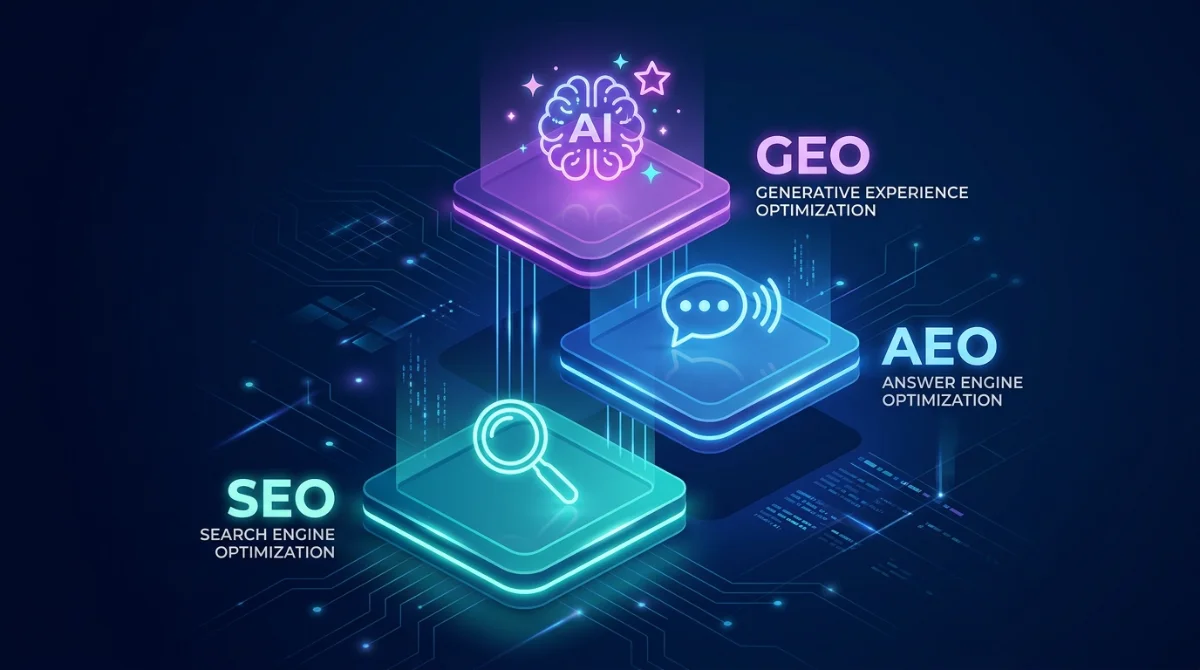
This shift has introduced three concepts shaping the future of digital discovery: SEO, AEO, and GEO.
Some claim that AI is replacing SEO, while others dismiss AEO and GEO as buzzwords. The reality is far more practical: they are complementary layers of a modern digital visibility strategy.
This comprehensive guide breaks down the real differences between SEO, AEO, and GEO, examines the technical mechanics of AI search systems, and provides an actionable blueprint to win visibility across both Google and generative answer engines.
The Search Evolution: From Indexing Engines to Synthesis Systems
To understand how these disciplines connect, let's look at the three major eras of search technology:
[Era 1: Index Engines (SEO)] ──► [Era 2: Answer Engines (AEO)] ──► [Era 3: Generative Engines (GEO)]
Focus: Ranked Blue Links Focus: Instant Snippet Answers Focus: Narrative Synthesis & Citations- The Index Engine Era (SEO - Search Engine Optimization): Google functioned primarily as a web librarian. Crawlers indexed pages, matched keyword queries, and presented a list of ten blue links ordered by PageRank and domain authority.
- The Answer Engine Era (AEO - Answer Engine Optimization): Searchers demanded faster answers. Google began extracting paragraphs, lists, and tables directly into Position Zero (Featured Snippets), People Also Ask (PAA) boxes, and voice assistant responses.
- The Generative Engine Era (GEO - Generative Engine Optimization): Searchers now engage in conversational dialogues with Large Language Models (LLMs). Platforms like ChatGPT, Perplexity, and Google AI Overviews analyze hundreds of web sources in real time, synthesizing comprehensive answers while embedding source citation links.
Deep Breakdown: Characteristics of SEO, AEO, and GEO
Let's examine the core focus, input patterns, and success metrics for each discipline:
1. SEO (Search Engine Optimization): The Architectural Foundation
SEO is the structural bedrock of digital presence. If your website lacks clean technical architecture, neither search crawlers nor AI retrieval bots can process your content.
- Core Focus: Ensuring web pages are fast, easily crawlable, and semantically relevant to target search terms.
- User Input Pattern: Short-tail keywords, such as
technical seo agencyorenterprise cloud hosting. - Success Metrics: Page-one keyword rankings, organic click volume, and technical site health.
- Strategic Role: Secures primary inclusion in the global search index. You can optimize bot crawl efficiency through crawl budget management.
2. AEO (Answer Engine Optimization): Capturing Instant Real Estate
AEO structures data so search engines can extract immediate answers directly onto the results page without requiring users to scroll or click through.
- Core Focus: Providing concise, structured, factual answers to specific questions.
- User Input Pattern: Interrogative queries, such as
how to calculate ttfborwhat is the cost of an seo audit. - Output Format: 40 to 50-word answer boxes, structured comparison tables, or step-by-step ordered lists above standard organic results.
- Success Metrics: Win rate of Featured Snippets and prominence in People Also Ask modules.
3. GEO (Generative Engine Optimization): Securing AI Brand Recommendations
GEO is the discipline of engineering your brand entity and content so that conversational AI models understand, trust, and recommend your brand by name.
- Core Focus: Strengthening entity authority, publishing original research (Information Gain), and building semantic trust across the web.
- User Input Pattern: Complex, multi-sentence conversational prompts, such as: "We are migrating our e-commerce platform to a headless architecture; compare SSR vs SSG and recommend specialized development partners."
- Output Format: Narrative AI summaries featuring embedded citation cards pointing directly to your website.
- Success Metrics: Frequency of AI brand citations across platforms (ChatGPT, Perplexity, Claude, Gemini) and positive recommendation sentiment. Explore the fundamentals in our complete guide to GEO.
Comprehensive Comparison: 7 Evaluation Dimensions
| Dimension | Classic SEO | AEO (Answer Engine) | GEO (Generative Search) |
|---|---|---|---|
| Primary Goal | Clicks to website URLs | Instant answer in SERP | Recommendation & citations by AI models |
| User Interface | Google search box | Featured Snippet & Voice Assistants | Interactive Chatbots & Google AI Overviews |
| Search Syntax | Short keyword strings | Direct questions (5W1H) | Conversational, nuanced multi-turn prompts |
| Ideal Content Format | Comprehensive long-form articles | 40-word definitions, lists, & tables | Primary research data, case studies, & expert quotes |
| Structured Schema | Standard (WebSite, Article) | Specific (FAQPage, HowTo) | Advanced (knowsAbout, sameAs, Entity Graphs) |
| Winning Factor | Keyword relevance & link equity | Clean, modular answer formatting | Unique Information Gain & verified brand entity |
| Business Impact | Broad exploratory traffic | High brand recall & instant visibility | Highly qualified, ready-to-convert prospects |
What Academic Research Says: Princeton University's GEO Study
Rather than guessing how AI engines prioritize sources, researchers from Princeton University, Georgia Tech, and the Allen Institute for AI published the first formal academic benchmark on GEO titled "GEO: Generative Engine Optimization" (arXiv:2311.09735).
Evaluating optimization methods across prominent LLM engines, the researchers revealed key visibility drivers:
- Cite Sources & Statistics (Boosts Visibility by 30–40%): Content assets featuring concrete metrics, original survey figures, and external citations achieve the highest probability of inclusion in AI responses.
- Add Authoritative Quotations: Large Language Models favor content incorporating verified quotes from recognized domain practitioners over generic summaries.
- Maximize Information Density: Direct, declarative language without conversational filler helps Retrieval-Augmented Generation (RAG) systems parse core factual claims, reflecting how ChatGPT, Perplexity & Gemini select citations.
- Avoid Recycled AI Content (AI Slop): Generative engines actively filter out derivative summaries. Thin, automated content is penalized across modern indexes, as analyzed in our breakdown of Google's S-CTS spam system.
Practical Implementation: The Integrated Content Framework
How do you execute all three disciplines without building three separate pieces of content?
The solution is an Integrated Content Architecture:
                 [ INTEGRATED ASSET ]
                           │
       ┌───────────────────┼───────────────────┐
       ▼                   ▼                   ▼
  [ Layer 1: SEO ]     [ Layer 2: AEO ]     [ Layer 3: GEO ]
  • Edge Architecture  • 50-Word Direct Def • Primary Research Data
  • Sub-100ms TTFB     • Comparison Tables  • Entity Schema Graphs
  • Keyword Relevance  • Ordered 1-2-3 Lists• Brand Co-occurrence
Step 1: Establish High-Speed Infrastructure (SEO Layer)
Before search bots or AI crawlers extract information, ensure your infrastructure responds instantly:
- Deploy a modern edge architecture with sub-100ms Time to First Byte (TTFB), as detailed in our web rendering comparison for SEO.
- Ensure your core commercial pages are free from redirect loops and crawl waste.
Step 2: Format Subheadings into Modular Answer Blocks (AEO Layer)
Structure every core section around genuine searcher questions:
- Place a concise 40 to 50-word direct definition immediately beneath each H2 or H3 heading.
- Format complex trade-offs into clean HTML tables.
- Use ordered numbered lists for sequential workflows.
Step 3: Inject Original Insights & Proprietary Data (GEO Layer)
Make your page a primary source of truth that cannot be found elsewhere:
- Include proprietary benchmark figures, customer survey data, or live execution results.
- Share specific technical challenges your team solved.
- Eliminate filler phrases; deliver immediate value in opening sentences.
Step 4: Reinforce Entity Graphs with Schema JSON-LD
Help search engines and AI models map your organizational authority:
- Implement
Organizationschema linking verified social and corporate profiles (sameAs). - Use
knowsAboutentity arrays to declare your core areas of domain expertise. - Cultivate positive brand mentions across reputable industry publications, podcasts, and professional forums.
Measuring Success Across SEO, AEO, and GEO
To evaluate the commercial return of an integrated strategy, monitor these distinct performance metrics:
- SEO Metrics (Reach & Index Volume):
- Track organic click growth and impressions within Google Search Console.
- Monitor average position improvements across commercial target keywords.
- AEO Metrics (Answer Dominance):
- Use SERP tracking tools to monitor the number of Featured Snippets and People Also Ask blocks won.
- Observe CTR improvements on informational queries driven by rich answers.
- GEO Metrics (AI Citations & Lead Quality):
- Run structured prompt tests across ChatGPT, Perplexity, and Gemini to verify if your brand is recommended for core industry queries.
- Track referral traffic originating from AI domains within web analytics.
- Monitor sales cycle velocity: prospects arriving via AI recommendations typically enter sales conversations with high trust and shorter closing timelines.
Conclusion: Three Dimensions of Market Leadership
SEO, AEO, and GEO are not competing tactics; they form a unified modern search ecosystem:
- SEO drives top-of-funnel reach and secures foundational indexability.
- AEO captures prime instant real estate at the top of Google search results.
- GEO secures authoritative brand recommendations within generative AI environments.
Brands that implement this integrated framework today will establish an enduring competitive advantage as search habits continue to evolve.
To discover how your business can build an integrated search and AI visibility strategy, explore Venti Digital's SEO, AEO & GEO services or request a consultation with our team today.
Authoritative Research References & Sources
- Princeton University, Georgia Tech & Allen Institute for AI: GEO: Generative Engine Optimization Academic Research Paper (arXiv:2311.09735)
- Search Engine Journal (SEJ): The Evolution of Search: Practical Differences Between SEO, AEO, and GEO
- Gartner Research: Predicting the Transformation of Search Marketing and AI Discovery
- Pew Research Center: Consumer Search Habits & The Zero-Click Search Paradigm
- Google Search Central: Structured Data Guidelines & Search Ranking Documentation
- Venti Digital Technical Insights: What is GEO (Generative Engine Optimization)? Complete Guide