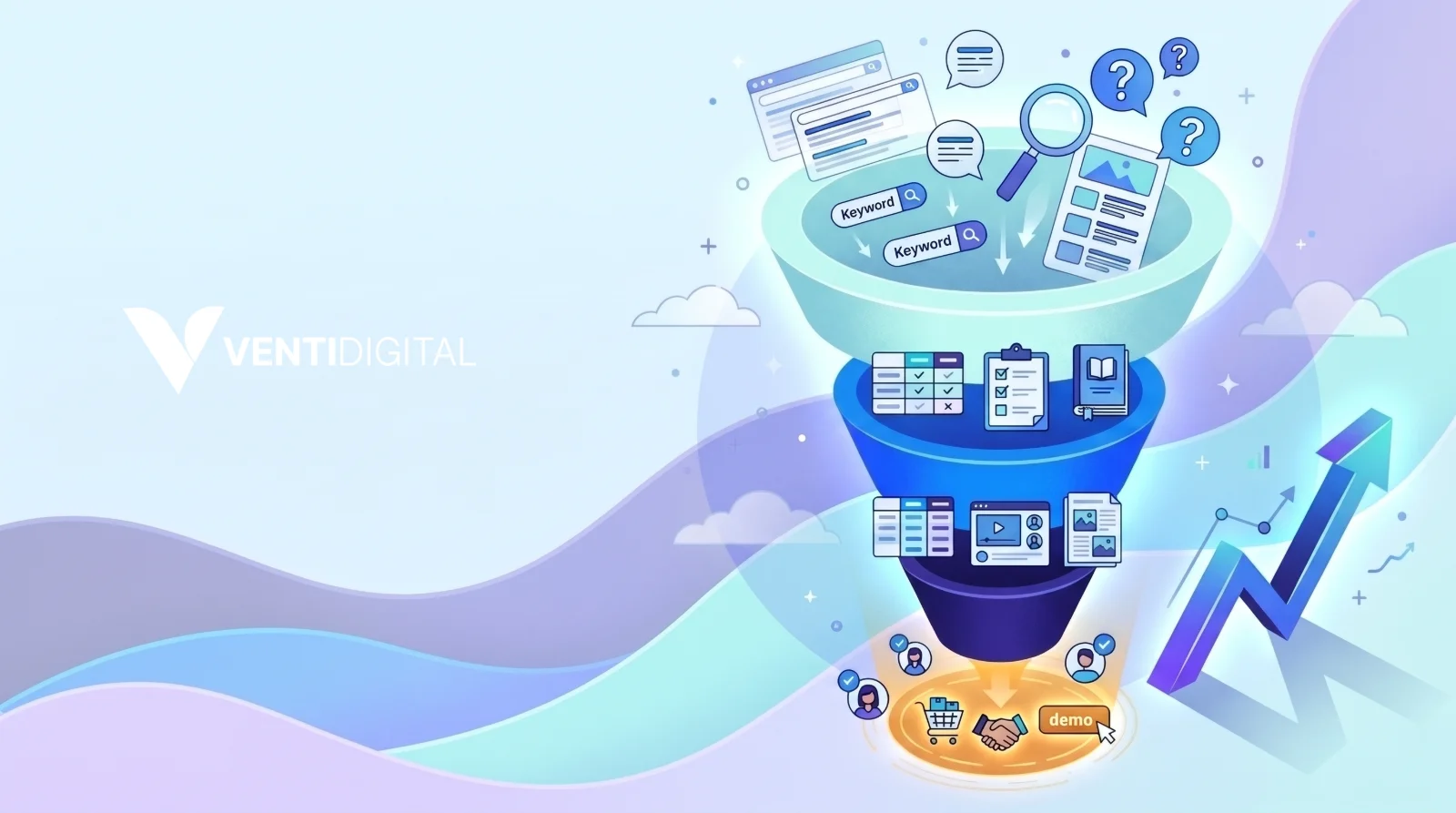
Plenty of websites get decent traffic but few leads. Others have the opposite problem: strong service pages that almost nobody finds. Both usually share the same root cause: content is not mapped to the buyer's journey.
A content funnel answers a simple question: for each person searching on Google, which stage are they in, and what content best helps them move to the next one? This guide covers how to map keywords to the funnel, choose formats and CTAs, build internal links, and measure results.
Key Takeaway: What Is a Content Funnel in SEO?
A content funnel groups content by buyer stage: TOFU (top of funnel) for people just becoming aware of a problem, MOFU (middle of funnel) for those comparing solutions, and BOFU (bottom of funnel) for those ready to choose a provider. In SEO, each stage is recognized by its keyword patterns, served with different content formats, and connected through internal links so readers can move forward.
The Funnel Is Not a Straight Line
The funnel model makes planning easier, but real buyer journeys are rarely linear. Google's 2020 research, Decoding Decisions: Making Sense of the Messy Middle, describes the space between a trigger and a purchase as the messy middle. In this space, people move back and forth between two modes: exploration, which expands their options, and evaluation, which narrows them down.
So one person might read a MOFU article, go back to basic research, then compare again before finally contacting you. Use the funnel as a mapping tool, not a forced path. What matters is that every stage has content, and that the content is connected.
Recognizing Funnel Stages from Keyword Patterns
The most practical way to map keywords is to look at the modifiers searchers use:
| Stage | Searcher need | Keyword pattern | Examples |
|---|---|---|---|
| TOFU | Understand a problem or topic | what is, how to, why, tips, guide | "what is SEO", "why isn't my website on Google" |
| MOFU | Compare approaches or solutions | best, vs, comparison, pros and cons, review | "SEO vs Google Ads", "how to choose an SEO agency" |
| BOFU | Choose a provider and act | services, pricing, cost, in [city], consultation, brand name | "SEO agency in Surabaya", "SEO pricing" |
| Post-purchase | Use the product or service well | how to use, setup, troubleshooting | "how to read Search Console reports" |
These patterns are not always clear-cut. "SEO pricing" might come from someone researching budgets (MOFU) or someone ready to buy (BOFU). The best way to check is to look at Google's results for that keyword. If the top results are guides, Google reads the intent as informational. If service pages and Google Maps appear, the intent is transactional.
For a deeper look at intent, read our guide to keyword research for buyer intent.
Example Mapping by Industry
| Industry | TOFU | MOFU | BOFU |
|---|---|---|---|
| Dental clinic | "causes of sensitive teeth" | "veneers vs bonding" | "dental clinic in Kemang" |
| HR SaaS | "how to calculate employee overtime" | "best HR software for small businesses" | "[brand] payroll software pricing" |
| Property developer | "mortgage requirements for contract workers" | "house vs apartment for young families" | "housing near Cisauk station" |
| Hotel | "things to do in Ubud" | "stay in Ubud or Seminyak" | "villa with private pool in Ubud" |
| Law firm | "employee rights when laid off" | "mediation or lawsuit, which is better" | "employment lawyer in Jakarta" |
Content Formats and CTAs for Each Stage
A common mistake is using the same CTA on every page, usually "Contact Us". TOFU readers are not ready for that.
| Stage | Content format | Fitting CTA |
|---|---|---|
| TOFU | Guides, definitions, checklists, infographics | Read a related article, download a checklist, subscribe |
| MOFU | Comparisons, case studies, selection guides, webinars | View case studies, try a free tool, book an intro call |
| BOFU | Service pages, pricing pages, location pages, sales FAQs | Request a quote, schedule a consultation, contact via WhatsApp |
| Post-purchase | Documentation, tutorials, usage FAQs | Contact support, explore advanced features |
A stage-appropriate CTA feels helpful rather than pushy. Readers who are not ready to buy can still take the next step.
Connecting Stages with Internal Links
A funnel only works if its content is connected. A common pattern:
- TOFU articles link to relevant MOFU content. For example, "why isn't my website on Google" links to "how to choose an SEO agency".
- MOFU content links to BOFU pages. The agency selection guide links to service or industry pages.
- BOFU pages link back to supporting content, such as FAQs or case studies, for readers who are still unsure.
- Use descriptive anchor text, not "click here", so readers and search engines know what the target page is about.
This structure also helps Google understand which pages matter most on your site, because BOFU pages receive links from many supporting pieces.
Common Content Funnel Mistakes
- Only creating TOFU content. Traffic rises, but no page turns readers into leads.
- Only creating BOFU pages. Service pages compete for very competitive keywords with no supporting content, and the brand is unknown before buyers are ready.
- TOFU content unrelated to the business. Popular articles with no link to your services rarely bring leads.
- No links between stages, so readers stop at the first article.
- Measuring all content the same way, such as judging TOFU articles only by direct leads.
Content Funnels in the Age of AI Search
Google AI Overviews and AI assistants like ChatGPT now answer many TOFU questions directly on the results page, so some readers no longer click. This changes the role of each stage:
- TOFU: value shifts from clicks to the chance of being cited as a source by AI. Clear definitions, direct answers, and citable data become important.
- MOFU: comparison questions are increasingly asked to AI, such as "which one suits me better". Honest, structured comparison content has a strong chance of being cited.
- BOFU: remains where decisions happen. Clear pricing, location, and service information helps AI recommend you accurately.
How to Measure Each Stage
| Stage | Main metrics | Data source |
|---|---|---|
| TOFU | Impressions, clicks, new users, likelihood of AI citation | Google Search Console, GA4 |
| MOFU | Engagement time, clicks to BOFU pages, micro-conversions like downloads | GA4 |
| BOFU | Leads, quote requests, WhatsApp and phone clicks | GA4 (key events), CRM |
In Google Analytics 4, important actions such as form submissions or WhatsApp clicks are recorded as key events (previously called conversions). Use GA4's path and attribution reports to see which TOFU and MOFU articles people visit before becoming leads, since that contribution rarely shows if you only look at the last page.
Content Funnel Checklist
| Step | What to confirm |
|---|---|
| Mapping | Every priority keyword has a funnel stage |
| Validation | Intent is checked directly in Google's results |
| Coverage | Every core service has TOFU, MOFU, and BOFU content |
| CTAs | CTAs match the reader's stage |
| Internal links | Each stage links to the next |
| Measurement | Different metrics per stage, key events set up in GA4 |
Conclusion
A content funnel is not about producing more content. It is about making sure every buyer stage has the right content, and that it is connected. Start with the services that matter most to your business, map keywords at each stage, fill the gaps, then connect them with internal links and measure with the right metrics.
To see how this applies to specific sectors, contact our team for an audit of your current content.
Frequently Asked Questions
What is the difference between TOFU, MOFU, and BOFU?
TOFU serves people just becoming aware of a problem, MOFU serves those comparing solutions, and BOFU serves those ready to choose a provider or buy.
Which stage should we create first?
For businesses with existing demand, start with BOFU so ready-to-buy searchers find the right pages, then build MOFU and TOFU to support them. For newer categories, TOFU and MOFU content helps build awareness first.
How do you identify a keyword's intent?
Look at Google's results for the keyword. The type of page dominating the top results, whether articles, comparisons, or service pages, shows how Google reads its intent.
Is TOFU content still useful if AI Overviews answer it?
Yes. Clear, accurate TOFU content can be cited as a source by AI, builds brand awareness, and still brings readers who want a fuller explanation.
Sources and References
- Think with Google: Decoding Decisions: Making Sense of the Messy Middle
- Think with Google: How do we decode the messy middle of the consumer purchase journey?
- Google Search Central: Creating helpful, reliable, people-first content
- Google Search Central: SEO Starter Guide: link wisely
- Google Analytics Help: Mark events as key events
- Ahrefs: Search Intent in SEO: What It Is and How to Optimize for It
- Smarter With Gartner: B2B Sales Reps: Maximize Customer Interactions